 Asian Americans/Pacific Islanders in Philanthropy (AAPIP)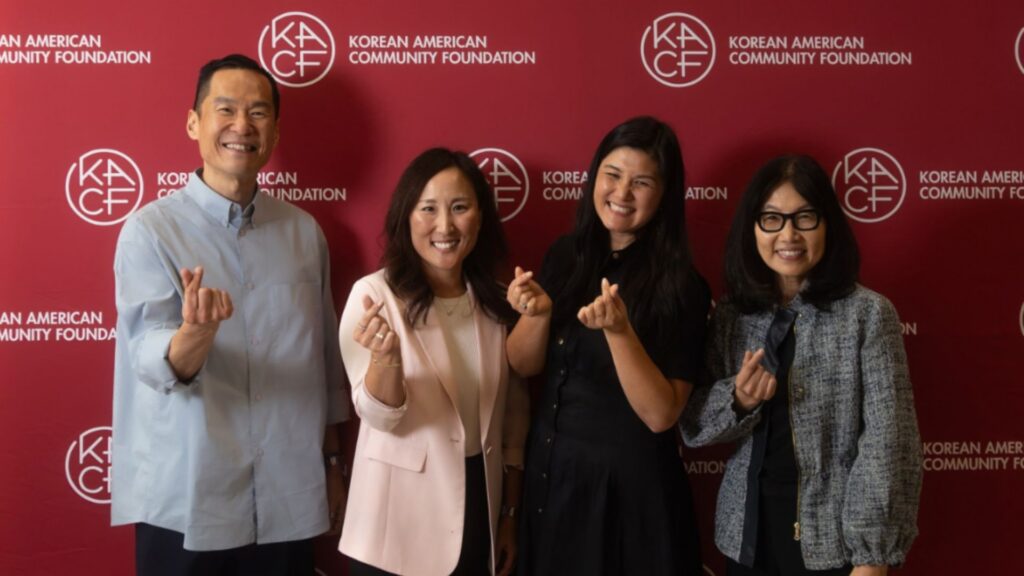
AANHPI communities are directed just 34 cents of every $100 in institutional philanthropy which is somehow still a 70% increase from 20 cents where we were in 2019, the last time we measured for a report. According to AAPIP’s 2025 AANHPI Funding Snapshot, donor-advised funds and community foundations drove 47% of the growth in that funding. Today, October 8th, is DAF Day so I want to share what I saw last Saturday in San Francisco at the Korean American Community Foundation’s (KACF) Giving Summit. It changed what I think we can ask of donors.
KACF brings its community-based organization grantees together from across the country on Fridays for site visits and conversations. Saturday is for donors. The day opened with short talks from three Korean American CBO leaders, and none of them cited policy or community statistics. They told personal stories.
One young woman described giving up medical school to work with seniors at Maru Center in the East Bay. Her parents ran a deli and worked 362 days a year, and they were crushed with her choice. Friends asked why she would spend a Berkeley education on a nonprofit. She said she wanted to change community health at the systems level. Eventually, those around her could see the value as well and she ended with photos of her father proudly holding signs and giving public testimony to support the organization his daughter works at, which left the audience in tears. Another community leader from NAKASEC in Chicago talked about applying for college, which is how he discovered he was undocumented. Eventually, after getting temporary protection under the Deferred Action for Childhood Arrivals (DACA), he biked cross-country, choosing a path where he could interact with Americans who might never had met an Asian immigrant before. He finished with everyone on their feet to join him in a group cheer.
Later, I moderated a panel with Daniel Lee, Cathy Cha, and Anne Im. All three come from immigrant households, and worked in Korean or AANHPI community organizations before they moved into philanthropy. They pointed out that the world now has K-beauty, K-drama, and K-pop, and said we need K-giving that doesn’t copy a lukewarm version of White philanthropy. They joked about going “full on Korean” with our giving, which I took to mean full throttle. Their argument for why Korean donors can do this is that many are one generation from being on the receiving end of help, and now they have the room to give it.
When it comes to getting high-net-worth donors to make bigger bets on community organizations, they advised to use language that private sector donors understand, not the vocabulary we often hear in institutional philanthropy And help donors envision the major impact their big investment will make. If the change is big and bold, the gift tends to follow.
The next panel covered DAFs and family foundations, with Joy Wheeler of the Charles Kim Family Foundation, Jeannie Park, who chairs KACF, and Sandra Schubert of Goldman Sachs. Sandra covered the tax benefits of funding a DAF and setting up legacy gifts now. Joy said a family foundation gives you more operational control over the work you want to do, but also more work to set up. Jeannie started with a corporate DAF and later opened one at a public foundation that’s more values aligned. Giving from DAFs offers anonymity which can have benefits at this time, but she now gives more directly to put her name behind the causes she believes in, plus DAF can’t pay fora galas.. Her advice to the room was to give more, give now, and stop overthinking it; the organizations need the money now.
The last panel was three KACF supporters. One brought her mother, another brought her parents and grandparents, and one brought Audrey Nuna from KPop Demon Hunters/Huntrix! They talked about how giving brought them closer to their children, gave them a way to build a legacy, and tied them to their Korean identity even when they hadn’t felt accepted growing up. Similar to “going full-on Korean,” she said the power of K-giving is once the “kimchi is out of the bottle.”
Speakers referenced the data from AAPIP’s funding snapshots repeatedly that day. I felt the pride and energy in that room – as a Korean American, AANHPI donor, and a representative of AAPIP to be a bridge builder between philanthropy and our communities. I keep asking myself whether AAPIP can bring more of that energy and passion to AANHPI donors across the country on behalf of our communities.
For DAF Day, I have two asks:
First, if you hold a DAF, consider recommending a grant this week to an AANHPI-led organization. Second, if you work at a community foundation or DAF sponsor, tell your donors where AANHPI-led organizations are doing the work. TAAF has a robust searchable database of AANHPI organizations by state and issue area and AJSOCAL’s database is available in different Asian languages. The funding data exposes the gap, and the giving summit reminded me that people give when they can see themselves in the story.
If you want to talk about what this could look like at a larger scale, write to us at aapip@aapip.org.